Contemporary Art at the Museum of Copenhagen
Why contemporary art in a museum dedicated to the history of Copenhagen, you might ask? Contemporary art can help create cracks in the framework of the cultural-historical museum. A surprising element that opens the visitor’s gaze to connections and overlapping phenomena between past and present. In this way, art adds new dimensions and reflections to the exhibited objects and overarching themes.
At the Museum of Copenhagen, we continuously develop artworks and collaborations – inviting contemporary artists to cast new perspectives on our exhibitions and collection.
At present, the following works can be experienced at the Museum of Copenhagen:
Gudrun Hasle // You Took My Hand (2026)
Gudrun Hasle is a visual artist who, since graduating from the Royal Danish Academy of Fine Arts in 2008, has created art based on her dyslexia and personal life. The spelling in her works reflects how she herself experiences words – full of spelling mistakes. Dyslexia thus often becomes both a focal point and a method in her works.
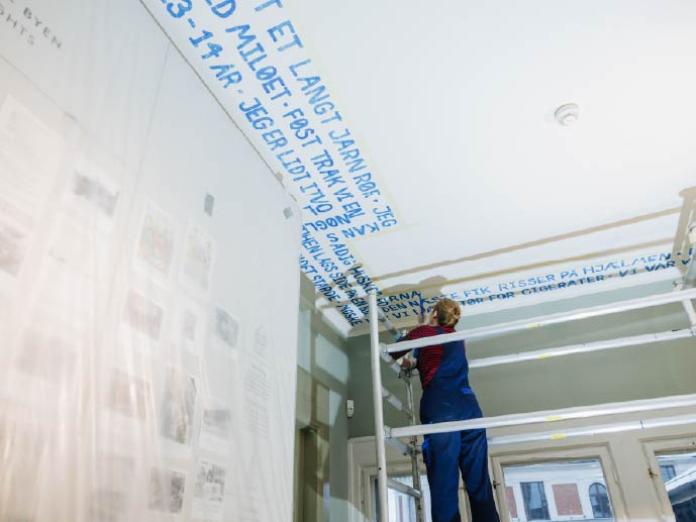
For the exhibition space “The Struggle for the City”, which deals with activist movements in Copenhagen – from the Squatters to the BZ Movement – Hasle has created the work You Took My Hand. It is a text-based work executed as a ceiling painting in the room, written in blue, handwritten text. The text tells her personal story of how she and a friend, when they were young, run through the city at night, smashing car windows with iron pipes and looking for a place to buy cigarettes. In the end, they find themselves sitting on top of a climbing frame in a playground.
The work speaks directly into the theme of the room and provides a personal, artistic, and contemporary perspective – creating an emotional connection between the artwork, the history presented at the museum, and the viewer. Allowing an artist to paint directly onto the museum ceiling emphasizes the very theme of activism: who has the right to the city and to history? And which stories are told in the museum space?
Gudrun Hasle on the work
“On the top florr of the Museum of Copenhagan, there is a small room, where the histiory of the slumstormer/bz movment is. I want to paint a long tekst on the ceiling, that is about me and my frends. How we run through the city, with an iron pipe and smash car windows. How on another night we look for a place to buy sigarets, how the light is, we see a fox and at last sit on the top of a climbing frame.”
The work is supported by the New Carlsberg Foundation.
Gudrun Hasle // I Only Fall in Hard Times
"I Only Fall in Hard Times" is a stained-glass work in the museum’s entrance hall, created on a window facing the street. When standing in the museum’s large foyer, the first thing you see is a large glass mosaic by the artist Agnes Slott-Møller, depicting herself holding her small daughter, surrounded by other women. The mosaic was made for the building when it functioned as the Guardianship Office from 1896. The Guardianship Office was an institution that managed the assets of legally incapacitated individuals – including orphaned children and women. Agnes Slott-Møller thus depicted herself among the legally incapacitated. The infant in her arms is her daughter, who had died shortly before – making the mosaic also a memorial to her.
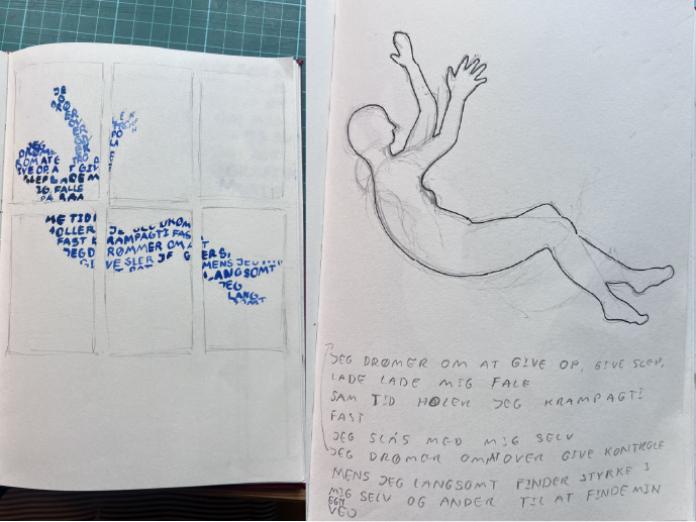
Gudrun Hasle’s work is created for a window in the entrance hall – a few steps lower and to the left of Agnes Slott-Møller’s mosaic – allowing the two works to reference each other. Two different portrayals of women, woven together across time. Gudrun’s work is also a kind of self-portrait: a stained-glass image of a falling body, formed by words. The text relates both to the history of the building and to Agnes’ story, while also telling of Gudrun’s life, emotions, and connection to Copenhagen. The work also deals with depression and a desire to let go of life.
Gudrun Hasle writes about the work herself:
“I only fall in hard times. Is a work painted with glass paint. diractly on a window part consisting of 6 window panes, in the entrance hall of the Museum of Copenhagan. When you stand in the entrance hall you can see an old glass mosaic made by Agnes Slott-Møller. The work will relate to her work and the history of the house. At the same time as it tells a part of my history, my feelings, from the time where I felt closely connected with Copenhagen/Northwest. The work is a silhouette of a body that falls. The silhouette is made out of words. The words are a text about the wish to let go, under a depression, but at the same time not being able to do it fully.”
The work is supported by the New Carlsberg Foundation.
Jacob Kirkegaard // Naufragium
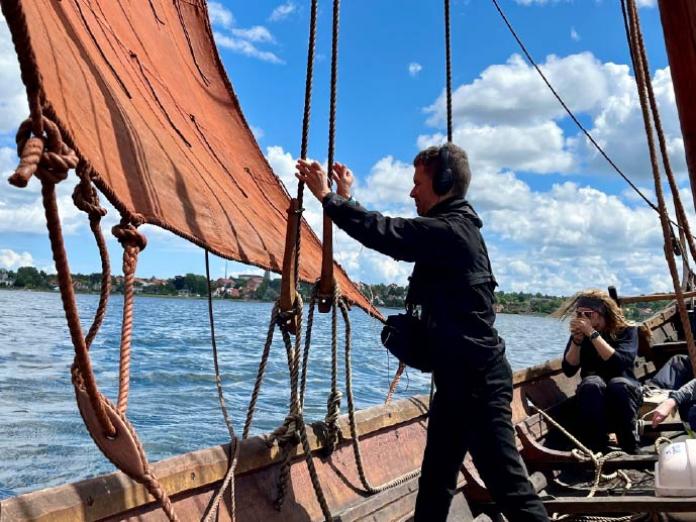
Danish sound art pioneer Jacob Kirkegaard has created the sound work Naufragium (Latin for “shipwreck”) for one of the museum’s permanent galleries dealing with the harbor and the history of the capital in the period 1400–1600. The main object in the gallery is a fourteen-meter-long shipwreck from the 15th century.
The work takes us beneath the surface, into another time and world. Using the sea as a metaphor for the subconscious, Naufragium creates a sensory connection to the ship. Kirkegaard always works with his own recordings and, for this composition, has collected sounds from the depths of Copenhagen Harbor, wind from the sails of historic ships, as well as sounds from Venice.
The work is supported by the New Carlsberg Foundation, the Obel Family Foundation, and the Augustinus Foundation.
Peter Callesen // Lines of Thought
The exhibition space “The Power of Words” deals with literature, reading, reviewing, and authorship in Copenhagen, focusing on the reading revolution of the 18th and 19th centuries. The period was marked by changes in reading habits and the book market, helping shape a new literature and a new type of author, such as Johannes Ewald, Charlotte Dorothea Biehl, Adam Oehlenschläger, and Søren Kierkegaard.
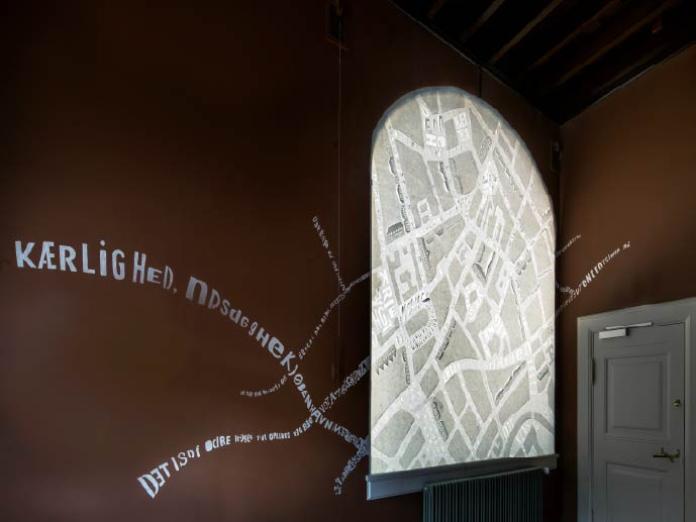
In the space, artist Peter Callesen has created a work that explores the relationship between the city, communication, the reader, and the author across time, and brings the room’s themes into the present. For the space, Callesen has created an installation based on a series of Søren Kierkegaard quotes combined with a map of inner Copenhagen from 1855. The work covers the room’s largest vaulted window, in which four layers of paper are stretched. In the two outer layers, quotes, a city map, and various architectural elements are cut out. Some of the cut-out letters are glued back onto the streets as a fifth layer, while others move beyond the frame of the window and onto the walls of the room.
Peter Callesen works consistently with existential narratives in formats such as performance, sculpture, drawing, and paper cut-outs. Motifs and themes are inspired by myths and dramas known from fairy tales, religions, and other archetypal stories, which Callesen transforms into unnatural, absurd, and fateful situations. In his most recent works, he has focused specifically on materializing language.
Peter Callesen on Lines of Thought:
“It is strongly inspired by Kierkegaard’s habit and joy of wandering through the streets of Copenhagen while thinking and philosophizing. ‘Above all, do not lose the desire to walk: every day I walk myself into a state of well-being, and walk away from every illness; I have walked myself into my best thoughts,’ wrote Kierkegaard. The title Lines of Thought is also a direct reference to this quote. I see the cut-out letters as a kind of footprints moving through the streets of Copenhagen.”
The work is supported by Spar Nord Foundation and the 15 June Foundation.
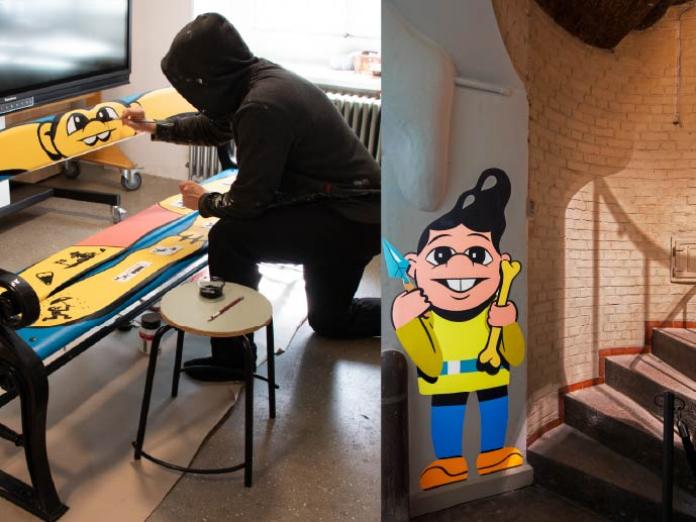
HuskMitNavn
HuskMitNavn has created a work in the area connecting the museum’s entrance to the raised basement in the museum’s north wing. The vaulted basement in the north wing forms the setting for the museum’s reception of children and young people, from daycare through upper secondary education. HuskMitNavn’s work in the central space between the museum entrance and the education department relates to what can be called “the musealization of the city,” aligning with the education department’s focus on giving children and young people insight into—and making them participants in—the working methods and processes behind the scenes of a city museum.
Children and young people are involved in everything from examining archaeological finds to conservation work and the communication of the city’s material cultural heritage, thereby taking part in the processes through which a museum transforms things into museum objects. HuskMitNavn’s work supports the connection between the learning processes that take place in the vaulted basement and those occurring in the museum’s other functional and exhibition spaces.
Over the past ten years, HuskMitNavn has exhibited extensively both nationally and internationally, and with roots in street art and graffiti, has made his way into art museums and galleries. Most recently, his works have been exhibited at ARoS and in New York, and he has been responsible for a comprehensive artistic decoration of Copenhagen’s new cultural center, the Library in the Nordvest district.
In HuskMitNavn’s works, one encounters the often overlooked and marginalized parts of the population, places, and everyday situations that are part of our reality, but which we do not always see.
The decoration is supported by Spar Nord Foundation and the 15 June Foundation.